


CLOs: A More Selective Opportunity Set
CLOs remain supported by resilient fundamentals, strong demand and attractive carry, but compressed spreads and growing collateral dispersion are raising the bar for credit selection, manager discipline and portfolio construction.
The backdrop for CLOs remains constructive. Credit markets have continued to hold up despite uncertainty around inflation, rates and geopolitics, supported by resilient corporate earnings and steady demand for income-oriented credit. For CLOs, that has reinforced the asset class’s core appeal: floating-rate coupons, structural protections and diversified exposure to senior secured loans.
Despite the supportive backdrop, however, the market is becoming increasingly selective. Valuations are tighter, true new issue formation remains limited, and refinancing and reset activity continue to dominate issuance. As a result, investors are spending more time evaluating seasoned portfolios, where collateral quality can vary meaningfully and outcomes are becoming more dependent on credit selection than broad market direction.
CLOs continue to offer attractive carry, but dispersion across credits, sectors and vintages is likely to remain elevated. In this environment, careful underwriting and manager selection will be central to navigating the next phase of the market.
Fundamentals: Stable, But More Differentiated
Fundamentals in the underlying loan market remain broadly stable. Default rates have improved modestly in both the U.S. and Europe, and broad credit performance has held up better than many expected.
That said, risks are becoming more issuer- and sector-specific, with the market increasingly differentiating between stronger borrowers and those facing liquidity pressure, refinancing challenges or structural headwinds.
Software remains one of the clearest examples of this dispersion.
- AI-related disruption has prompted renewed focus on software exposure across CLO portfolios, particularly in the U.S., where the sector represents a meaningful share of the loan market.
- Investors are moving beyond broad assumptions and evaluating individual business models, competitive positioning and potential disruption risks.
- The question is no longer how much software exposure a portfolio has, but what kind.
More broadly, recent idiosyncratic credit events and diverging sector performance are a reminder that risk is not concentrated in one area of the market. While software remains the most visible pressure point, other sectors are moving on their own fundamentals—reinforcing the need to evaluate risks at the issuer, sector and portfolio level.
Ratings migration also bears watching. While CCC exposure and downgrade activity do not point to broad-based deterioration, they can affect manager flexibility and portfolio construction—particularly in more seasoned CLOs where weaker credits may already be more visible.
Technicals: Supportive, but Uneven
Technicals remain supportive overall, helped by steady demand from institutional investors and CLO ETFs, which have seen more than $10 billion of inflows year to date. Repricing and reset activity has also been substantial, as managers look to lower liability costs, extend existing deals and improve equity outcomes. At the same time, managers have generally remained disciplined about new issuance, rather than forcing new deals into a challenging arbitrage environment.
CLO ETF Flows ($millions)
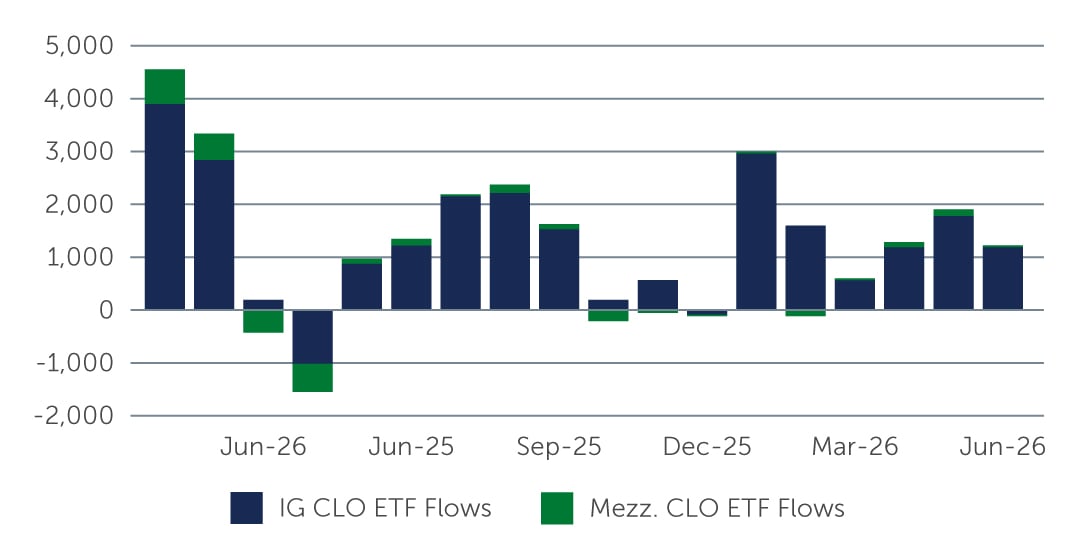 Source: Bank of America Factbook. As of June 30, 2026.
This activity has helped keep the market well supported, but it has also changed the opportunity set investors are evaluating. With true new issue formation more limited, investors are often looking at seasoned portfolios rather than newly ramped deals, which places more emphasis on collateral.
Regulatory developments will also shape demand going forward:
- In the U.S., the NAIC’s finalized risk-based capital framework is expected to be supportive for AAA through single-A CLO tranches, particularly among insurance buyers, while junior BBBs and lower-rated tranches may face less favorable capital treatment.
- In Europe, Solvency II-related changes could provide an additional tailwind for demand at the top of the capital structure.
Rating agency methodology changes could also influence the market in the months ahead. Fitch and Moody's have proposed updates that could result in a significant number of CLO tranche upgrades, adding another layer of complexity to how investors evaluate ratings migration and relative value across the market.
Opportunities Across the Capital Structure
The most attractive opportunities remain concentrated in higher-quality parts of the capital structure:
- AAA through single-A tranches continue to offer compelling carry relative to their risk profile, supported by strong structural protections and diversified exposure to senior secured loans.
- For investors focused on capital preservation, liquidity and income, these tranches look particularly appealing—especially in an environment where spreads are tighter, but macro and credit uncertainty remain elevated
Shorter-duration refinancing deals also look attractive in certain cases, especially where investors can earn spreads comparable to longer-dated transactions while reducing exposure to collateral deterioration over time. This is particularly relevant given the volume of seasoned deals coming back to market through refinancings and resets. That said, selectivity is key—in these deals, it’s not just about accessing spread, but understanding the underlying portfolio and whether the compensation is sufficient for the associated risks.
Mezzanine tranches offer more selective opportunities.
- Certain BBs look attractive, particularly when backed by cleaner or higher-quality portfolios with limited exposure to challenged credits and tail risks.
- Older or more seasoned BB tranches may carry greater risk, especially where deals are past their reinvestment period, have limited excess spread or are no longer fully covered on a market-value basis.
Spreads by Rating
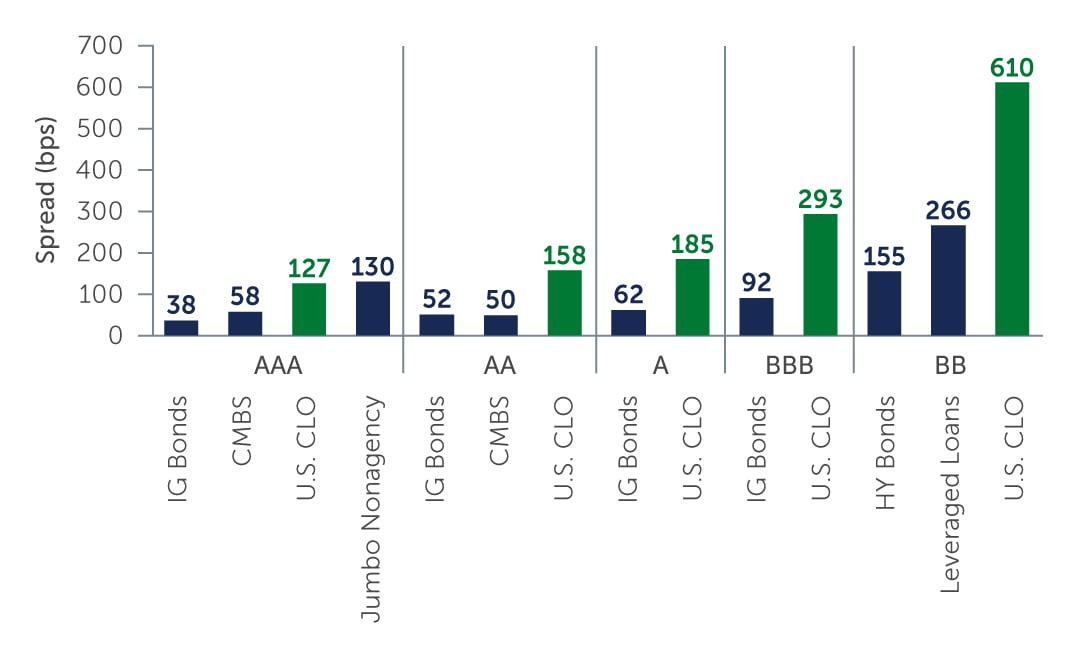 Source: JPM CLOIE. As of June 30, 2026.
Other Areas to Watch
Europe remains attractive. European CLOs continue to offer a spread premium to comparable U.S. securities and have generally experienced more stable performance in lower-rated tranches. Lower software exposure and supportive regulatory developments have both helped. Recent credit events, however, reinforce that the Europe story is not simply about spread, with portfolio composition and manager behavior remaining critical.
Private credit CLOs have also proven resilient. Despite concerns around BDC redemptions and broader scrutiny of private credit, issuance has continued and the market is gradually expanding in Europe. Relative value is more mixed today, but opportunities remain for investors willing to evaluate transactions on a deal-by-deal basis.
What’s Next?
The CLO market continues to benefit from strong demand, generally stable credit conditions and attractive income opportunities across the capital structure. At the same time, increasing dispersion across sectors, issuers and portfolios is creating a wider range of outcomes.
In this environment, the best opportunities are likely to come from careful positioning—favoring higher-quality tranches, cleaner collateral pools and managers with the ability to identify risks early.
26-5772764